

Tuning of AMPA receptor activation by inhibitory auxiliary subunits and epilepsy-associated disease mutations
Published on 09.03.2026 in Nature Communications
Thomas P. Newton, Maria V. Yelshanskaya, Muhammed Aktolun, Shanti Pal Gangwar, Laura Y. Yen, Alexey A. Alekseev, Ivan A. Sobolevsky, Maria G. Kurnikova & Alexander I. Sobolevsky
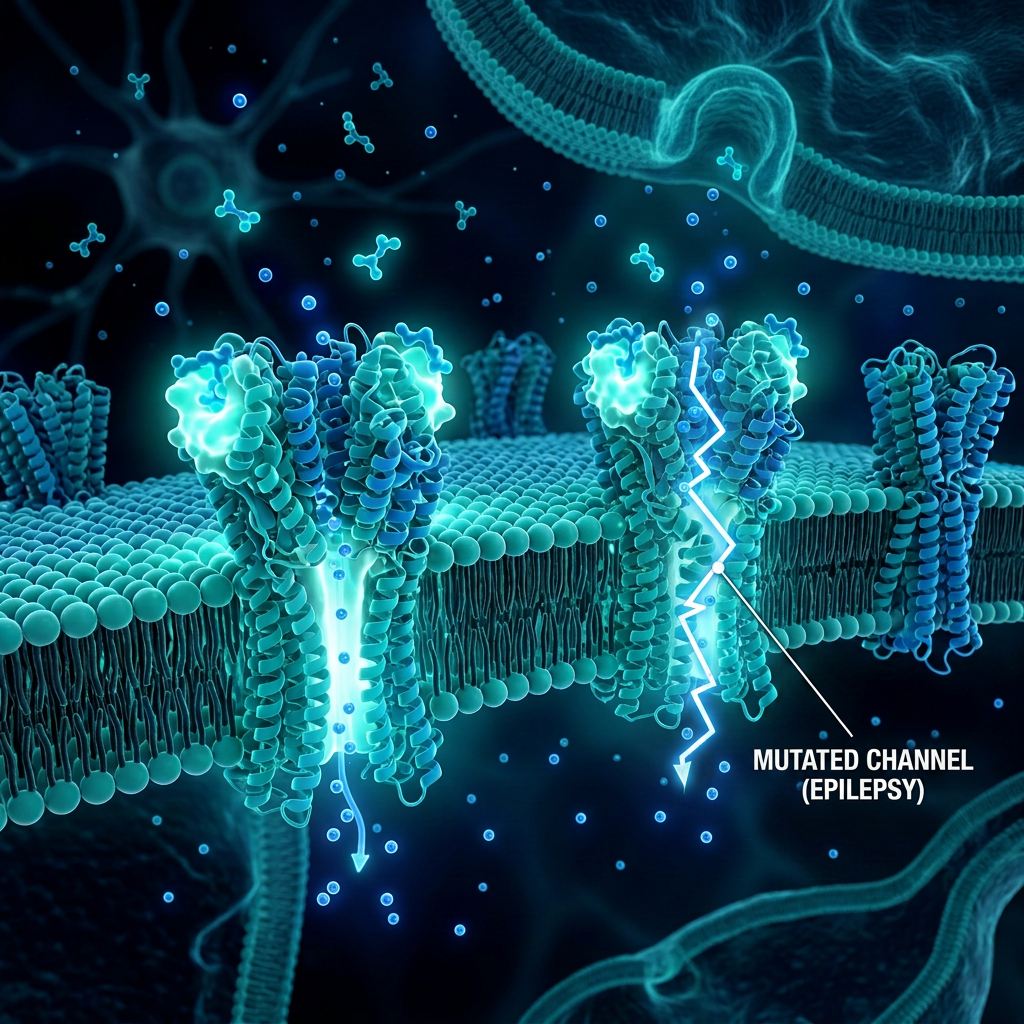
AMPA receptors (AMPARs) facilitate excitatory neurotransmission and are implicated in neurological and neuropsychiatric disorders. Binding of the neurotransmitter glutamate triggers AMPAR activation, which is modulated by potentiating and inhibitory auxiliary subunits. While modulation by potentiating auxiliary subunits has been studied extensively, activation involving inhibitory subunits has not been examined. Here, we present structures of the activated GluA2 AMPAR alone and in complex with inhibitory subunits GSG1L or γ5. Our results suggest that gating kinetics strongly depend on auxiliary subunit identity, while pore size and conductance do not. We find that receptor deactivation becomes slower if an auxiliary subunit promotes tightening of the interface between two ligand-binding domain dimers during activation. In addition, we functionally characterize the effects of epilepsy-associated disease mutations on AMPAR activation and desensitization kinetics, displaying strong dependence on the type of bound auxiliary subunit. Modulation by auxiliary subunits therefore has to be considered when designing AMPAR-targeting therapeutics.

This work was done in collaboration with Maria Kurnikova group from Carnegie Melon University.
The intro picture was drawn by AI based on the paper content.

Для отправки комментария необходимо войти на сайт.